Sibling Rivalry

As a parent of two, I sometimes worry that my children will encounter/experience sibling rivalry. My
children have fairly opposite personalities; while one is fairly shy and contemplative, the other is
boisterous and affectionate. But they both experience jealousy and have a temper to match that of a wild animals.

I do sometimes see one physically or emotionally hurt the other. And I know there is no stopping these
experiences; as a child, I endured it myself, and have relayed stories to those who have shared their sibling rivalry anecdotes with me. They tend to be the most hilarious stories to share. My children are young and have constant supervision in which intervention is continual, so fighting is fleeting, and effects are not permanent, but rather educational. I find it’s easy to teach them to be gentle and have empathy when they are so young, so I use these moments as a tool to prevent future fighting that could have bigger impacts. After all, it’s going to happen either way, so I use them to my Mommy advantage.

Why Children Fight:
· To get attention from their parents (“surely making my brother cry will get my mom to stop
cooking that horrible supper and pick me up”)
· To feel powerful (“I rarely have any say in what I eat or when I sleep but I can impose my
superiority over something that barely moves more than a potted plant”)
· Boredom (“annoying my brother while he is trying to watch his favourite show is so much more
fun than playing with the same old toys again”)
· To release energy (“why run when I can jump on someone who isn’t expecting it, from a great
height of course”)

What Children Learn from Fighting:
· They learn to manage, cope, and survive power struggles (“he won this round… but I’ll be back”)
· They learn to resolve conflicts by being open, communicative, sharing, and taking responsibility
for one’s actions (“I’m responsible for breaking the toy and he is responsible for my black eye”)
· They learn to be assertive and to stand up for themselves (“excuse me, I believe that’s my Barbie
Playdoh play set you are stealing”)
· They learn to negotiate and compromise (“okay, you take the heat for smearing diaper cream all
over the room and I’ll give you half of my dessert”)

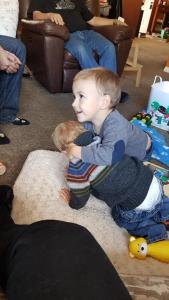
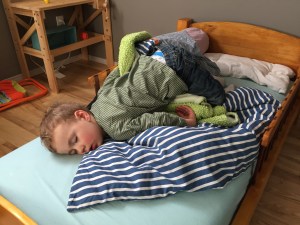
Through general parenting (or lack of parenting skills I should say), I’ve learning fighting can be influenced by physical factors such as hunger, illness, and fatigue. Addressing these needs often has a happy outcome, especially for the child experiencing the wrath of their grouchy sibling. My younger child, my Polar Bear, is a feisty little guy and will assert dominance over toys, often tackling his older brother while he isn’t looking to obtain them. However, my more docile child, my Grizzly Bear, can become very troublesome when tired. He often becomes giddy and flat out ignores rules, particularly the rule about jumping off of furniture.

This usually ends with Polar Bear getting squashed as his brother finds new ways
to entertain himself. Children grow through phases where fighting has different effects on them as they view the world differently through each stage.

Preschoolers
· These little tykes live in a dog-eat-dog world in which there is lots of fighting and parents must
intervene frequently

Young School-aged Children
· These impressionable minds adhere to a new rule, you scratch my back and I’ll scratch yours, and
parents intervene less and less

Older School-aged Children
· This law and order stage is a society where the children themselves use rules to guide actions and
determine fairness and parents, well, relax

High School and Beyond
· Yes, they have a human conscience now and resolve conflicts with techniques learned in earlier
phases (they still make poor decisions regarding safety and finances)

As my children are still both preschoolers, living in their dog-eat-dog world, it’s in my and my husband’s
nature to be in constant supervision mode. However, it’s important for us to remember that these first
five years are the foundation in which they will build the rest of their lives. I can’t stop, only teach.

Some Helpful Tips
· Encourage communication and understanding of feelings; help your children develop a sense of
empathy and respect for their siblings’ feelings
· Teach them how to resolve problems and let them know you believe they can be creative about
finding solutions
· Treat your children as the unique individuals that they are; if they are energetic and boisterous,
teach them to ask for high-fives rather than become physical; if they are sensitive and
communicative, teach them to strike conversations and make deals rather than scream
· Stay out of arguments that are harmless bickering, but don’t walk away; supervise the solutions
that they develop so that you can praise and encourage them And try to enjoy the young years full of bickering children, after all, these are the foundational years.

Remember how they learned these skills because they will be using them for the rest of their lives!
Mom of a “Boys Club”

As many women do when finding out the sex of their babies, I experienced a level of gender disappointment. My first child’s gender was a mystery during pregnancy. After the birth, I recall seeing a little willy and being slightly shocked that I had carried a boy for nine months without knowing it. During the 20 week ultrasound with my second pregnancy, we found out the gender.

My husband and I both felt the pains of realizing we would never have a daughter. Gender disappointment, to any level, makes parents feel guilty and ashamed to admit it. It’s not that the love you feel for a baby of either gender differs, it’s that the future you envisioned for your family is now a little different.

Growing up in a family of girls (and one boy), had me envisioning another family of girls. And even as I fell madly in love with my little boys, I felt a little apprehensive and like a fish out of water in this family of men. So, I took out some books on parenting boys and it turns out, I belong to a very special club, the Mom of Boys Club.

It turns out there were hundreds of books on being the mom of only boys, a little piece of knowledge that made my heart swell knowing that I was now part of a unique society. Additionally, each piece I read made me feel like I had special children, fiery children, children that make me look and feel stronger than I’ve ever been.

Ten Things I Love About Boys (and Being a Mom of Boys)

Boys are Fiery
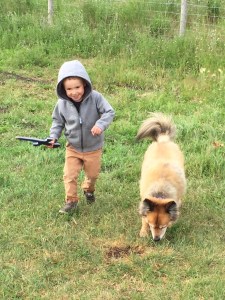
As the picture leading you to this blog dictates, boys have a fiery disposition. Not that girls don’t have spirit too; I’ve seen many girls throw on a good show. But boys jump right into the middle of danger to right all wrongs. They grab their swords and fight to the death!

Pranks and Jokes
Sure, men sometimes forget to call their Moms on their birthdays. I used to worry about this when I had my boys but then I recalled all the random prank calls I get from my nephew. They are just hilarious and admittedly better than a birthday wish. Even my young boys tend to love playing jokes. My Grizzly Bear continuously hides under blankets and behind potted plants to jump out and scare passersby. As he gets older, I can’t wait to see what he comes up with.

Extra Tough Play
My boys are still really little yet they play rougher than I ever did at any age. It used to make me jump in and intervene (save the baby!) but as I live day to day watching them jump off couches on to their unsuspecting victims, I sit back and watch with pride. I know that I can protect them from the world, but not from their brother.

For extra info on why rough play is important for kids, visit TodaysParent:
https://www.todaysparent.com/family/parenting/roughhousing-aggressive-or-constructive-behaviour/

The Protective Instinct
Boys are naturally protective. As we travel to the park daily, there is always the group of kids that want to pet our pup, Wylie. My Grizzly Bear plants his feet squarely and stands guard to supervise, continuously telling newcomers they have to be gentle.

The Gentle Touch
Boys can be surprisingly emotional and snuggly. The snuggles I get from my Polar Bear are just addictive. Plain and simply. He runs with open arms and collapses into my body. After MINUTES of just laying limply in my arms, he then nuzzles into my neck like a new puppy. Picking him up from dayhome is a tad embarrassing.

The Funny Noises They Make
Like anything with a digestive system, boys make horrifying sounds as gas passes through their bodies. The difference here is that instead of going red in the face and politely excusing oneself, boys burst into a fit of giggles and try to make it happen again. And again. And they egg each other on.

My House is Never Quiet
Along with their fiery spirit, boys never stop yelling. There’s never the gentle whisper that isn’t followed by the mischievous look in their eyes that lets you know they’re about to yell seconds after. In fact, if I tell them it’s quiet time, the volume just increases which makes it always feel like we’re having a party!

They Never Stop Moving
Back in my child free days, I worked weekends at KARA. The program always had about half a dozen girls and two boys. The Mom of these two boys now works at KARA too (Rosie) and I’ll never forget the smiles she tried to hide while pretending not to feel the floor shaking as her boys chased each other through the building. The girls, including myself, would all be colouring quietly and the entertainment would just be included for free without lifting a finger.

Boys Look Up to Their Dads
I’m sure everyone learns best through experience but I’m convinced the saying was made for young boys. Because they work hard to do what their Dad does and make him proud. With the amount of times I’ve tried to keep my youngsters out of the garage, where we keep all the tools, we’ve actually had to put up a baby gate so they can continually watch what he is making/doing. “No Mommy, I don’t want to see what you’re doing in the kitchen, just pass me that DeWalt pistol grip electric drill.”

Make Mom Look Like Superman
Lastly, when I step out of the house with two boys and a dog, I look like a superhero and get regular comments on it. “Wow, you have your hands full!” Passersby are always so impressed by me that it makes me feel good. And I know it’s true, I am a superhero.

So my boys are tough and strong and make me tough and strong. For a woman that has never belonged to a tough and strong club before, I’m glad to be part of the Mom of Boys Club.

Reading for beginners

Ah, the wonderful sound of silence that creeps throughout the house when a book falls open at a favourite page. That’s the moment in the evening that most parents wait all day for. The moment when you know it’s nearing your child’s bedtime and the busy little bodies stop being busy for a split second to see The Very Hungry Caterpillar turn into a beautiful butterfly.

My two Little Bears are busy all day long and continue to run, jump, yell, and destroy possessions even during our mandated book time. But we push forward with book time and do whatever is necessary to get them involved in reading because of how important it is for brain development.

Three years ago, a study on the importance of reading was conducted at the Cincinnati Children’s Medical Hospital, where 19 preschoolers between 3-5 years (37% from low income families) underwent MRI scans while listening to their parents read a story to them through headphones, with no visual stimuli. The study showed that greater home reading exposure (reading for short periods often) was associated with the ability to “see the story beyond the pictures, affirming the invaluable role of imagination.” They could actually see the part of the brain responsible for imagination increase in function while the children listened to a story. They concluded that early reading allows children to easily transition from books with pictures to books without pictures due to the neuron pathways built in this portion of the brain.

Another study, a 50 yearlong study conducted at Edinburgh University starting in 1958, followed 17,000 seven year olds in England, Scotland, and Wales. The study proved the connection between reading well and future job success. Because of the massive sample size (so many seven year olds), they determined that engaged readers from households with fewer material advantages (lower income families) routinely outperformed less engaged readers from families with many material advantages. It doesn’t matter how many books you have, just read them!

Additionally, Leonard Sax, a well-known psychiatrist and physician, states gender also plays a gigantic role on the outcomes of a child’s life, and boys tend to fair less than their gender counterparts. From Grade 3 through to Grade 12, there is a literacy gap between boys and girls. Boys tend to drop out of school more often, attend post-secondary school less often, get poorer scores than girls, and have greater behavioural and addiction problems. Leonard Sax attributes these differences to video games, particularly violent video games, and has numerous studies to back up his theory.

Having two boys myself, I wanted to know the antidote to Doom and Grand Theft Auto, and it turns out it’s reading! Reading fiction especially, as the astounding benefits come from empathizing with the characters’ hopes, dreams, joys, and downfalls. Through empathy, reading increases social functioning because literature doesn’t just help children learn emotions, but experience emotions, a form of practice for later life. With greater social functioning, comes greater control and desire to achieve.

The Edmonton Public Library has tips on how and when to read to youngsters:
• Read at least once a day when your child/children are in a cuddly mood
• Read for any length of time but short, positive reading sessions are much more valuable than long ones
• Repetition deepens understanding so read favourite books over and over (and over)
• Engage children by reading to exaggerated voices, acting out stories, and switching voices for different characters
• Read books that incorporate interaction – kissy/cuddly books are my favourite, dancing books are Grizzly Bear’s favourite (my 3 year old), and flip-the-flap books are my Polar Bear’s favourite (my 1 year old)

For more resources, understanding, ideas or tips on reading to young ones, please visit KARA and register in our Literacy and Parenting Skills or Books for Babies programs. Your public library will also have information and programs regarding the importance of reading to infants and preschoolers.

To check out the studies listed above, follow the links below (but try to mix in some fiction reading too)!
https://www.google.ca/amp/s/neurosciencenews.com/mri-early-reading-brain-activity-1996/amp/
https://m.huffingtonpost.ca/jerry-diakiw/reading-and-life-success_b_16404148.html

Separation Anxiety

I went back to work early with each of my children. With my Grizzly Bear, I returned to work at 10 months and with Polar Bear, 5 months. Each time, I was anticipating returning to work and leaving my children in the care of their allomother (see Blog 5), so I prepared myself, as well as my children, for the eventuality of separation anxiety.

I found, through research and attending KARA’s Grow With Me program, that separation anxiety was a wonderful developmental milestone that all children go through when developing the awareness of object permanence and apprehension to new situations. I know what you’re thinking, did you just read the word “wonderful”? Is this woman out of her mind? My child screaming and clinging to my body while other people pry him off so I can dash to my car is wonderful?

Let me be frank. My children never experienced the type of separation anxiety that you hear about. The ones that make you anxious and dread the day you need to drop your kids off somewhere. I’d like to say it’s because I’m a phenomenal mother or because I raised my little Bears to trust the entire world around them (which would actually be more frightening tome) but probably more likely that genetics played a role or that their dayhome allomother is a better caregiver than I am… (something else I’d like not to think about) so let’s get back to it!

Because I did experience an over the top, sweat behind your knees, and cringe in anticipation separation anxiety disorder the likes of which you’ve probably never dealt with, for a grand total of five years. Yes, five years. My experience with separation anxiety story occurred before doing my research and attending Grow With Me.

Before knowing that object permanence means that “Mom still exists but she isn’t here!? Where did she go? Did she just leave me here? If I scream loud enough, she’ll hear me and come back, right!?” Or before knowing children are genetically apprehensive of the new and that recognition is a huge component to cognitive development, so if I change my hair colour,the child is thinking “I don’t know this person! She looks completely different than yesterday!

This is not good, it’s just not good and she’s dead wrong if she thinks she can pull off black hair!”If you’ve guessed that my black hair phase was right in the middle of my babysitter career, you’d be correct. I babysat a child (and his siblings) for five years during my undergrad. And this littleboy loved his Mommy. In a way, I’m actually jealous. My Canadian Bears never put on a show of love like that. But I’m also grateful, because that child went through a turmoil of emotions each and every day.His Mom would call me up and ask if I had time to watch them for just a few short hours here and there, it was never a full-time gig.

She also would invite me over for help so she could complete chores around the house. This would also entail her going outside for a cigarette, where she’d only be absent for a few minutes, but the briefness of the absence didn’t seem to matter.Her child would shake the house with his displeasure. After a while, even the sight of me would trigger the anticipation of his mother leaving, and silent tears would start to role down his face hours before she would leave.I’m sure you can pick out the wrong strategies his mother and I used from these small windows now. As it wasn’t full-time and the days/hours were never consistent, the child never developed a sense of routine. It was always sprung on him and we never gave him time to adjust. When his mother would go outside to smoke, he could still see her through the window. The “out of sight,out of mind” combined with distraction practice that many of us use didn’t apply here.

Furthermore, seeing me well in advance of his mother leaving the house, lingering and anxious herself, never sat well in his tummy.Still, we had our fun with playing hide and seek, crafts, taking walks, and watching his favourite programs. You may think that five years of separation anxiety is a bit extreme but I know for a fact that they were able to overcome it because I still babysit them from time to time (althoughher youngest pretty much babysits mine while I have a lie down). And I know that their bond is undeniably strong.

Just this past weekend, their Mom told me “My youngest son brings me soup, he is my sweetest,my oldest daughter talks with me, she is my confidant, but he, he is enduring with love.”If you want more information and tips on how to make separation with your young child easier on both of you, I strongly recommend Parents Canada magazine and KARA’s Grow With Me free drop-in program. Parents Canada is full of advice from experts and their information on separation anxiety stems directly from the University of Toronto and pediatricians. I use ParentsCanada for research on behavioural patterns of children, mostly to see what stages my children are coming to next. They also have fantastic recipes.

The Grow With Me program I attended at KARA during both of my maternity leaves was educational and inspiring. The ladies that facilitated that program introduced me to the importance of routines and being honest with my children. The do’s and don’ts really did work as I sought the perfect dayhome for my kids. If you and your child are struggling with separation, give these two resources a try; they won’t disappoint you!

Bedtime Routines

When I first started researching bedtime routines (I was probably halfway along in my first pregnancy) I found some pretty interesting information. I knew that my husband and I wanted to include reading (at least twenty minutes a night), bathing (who doesn’t want to wash and pamper a little newborn?), and cuddling up with a little tune (I was very excited for this part!).

So, I checked out the information at hand. What I learned through googling, reading Alberta Health Care books, and talking with friends and family, albeit informational, nowhere near provided me for the little Grizzly Bear I was about to bring home. The rest of my three years of parental insight came from plain, old, on-the-job, firsthand experience – something every parent should remember.

What I did learn through research provided me with two tidbits of information that were extremely helpful; don’t start any routine that you don’t want to continue doing until you have a teenager and don’t bathe your baby too often.

The first one made sense right away. I certainly didn’t want to complete an hour-long ritual for bedtime or deal with a tantrum every night I’m unable to complete the routine. The second one made sense to me, as I’d studied microbiology in college. It didn’t make sense to my husband, so I explained: the societal mentality on cleanliness eradicates necessary microbes from our bodies, leaving room for pathogens.

Simply put, if I wash my son every day, the little microbes that are on his skin, the good microbes that I introduced to him by birthing him, breastfeeding him, and kissing him, would be continually under attack from the bath time wash cloth, leaving them unable to battle for space against new, potentially harmful microbes. So, we limited baths to twice a week, one bath with soap, the other with water, and occasional ones whenever he was actually dirty. This also worked with our busy lifestyle, especially when we introduced our little Polar Bear into the mix, making life just that much busier.

On-the-job training, with no manager, supervisor, or foreman available for questioning, was a bit different. Obviously, we let our baby be a baby, we fed him when he woke, cuddled him continuously, and read to him occasionally.

When our baby became a toddler (one year, yay!) we were so excited to start doing the actual bedtime routine and have him SLEEP THROUGH THE
NIGHT. We did as we intended from the beginning, we read to him for twenty minutes, cuddled him while singing a short lullaby, and then plopped him in his crib with a few soft toys.

We didn’t do anything we didn’t want to do every night for the foreseeable future. We didn’t cuddle him until he fell asleep, we didn’t wait outside his room to listen to his snoring, and we didn’t give in to his demands (unless he cried for more than 20 minutes as directed by pediatricians). As Grizzly Bear
grew older and started climbing out of his crib, we moved him to a toddler bed.

He was afforded more toys and books to help him fall asleep. We learned quickly that only board books survived his curiosity and that skinny ones could be shoved under the door, making for interesting clean up in the morning. As he grew older still, his demands became more coherent and adorable than
the pitched crying we used to hear.

“Mommy, my teeth are still dirty, I need to brush them.”
“Mommy, I was crying because I wanted a drink.”
“Mommy, I just wanted to go with you to get a slurpilee.”
“Mommy, there’s a poop in there. And my feet are stinky.”
“Sweetie, Mommy has to sleep too you know.”

These demands were harder to ignore because we knew what favorite toy he was asking for, we knew which favorite cup he wanted to drink water from, we knew which book made him the happiest, etc. However, we also knew that he knew we would only come back once to do whatever task he needed, so he’d better pick a long and arduous one.

Bedtime routines, psychological warfare, whatever you want to call it, it’s a very precious time, especially for those parents that work or only see their kids for short periods of time. Even though I’m tired at the end of the day, I like reading my son his favorite book for the eighth time. But not the ninth, because Mommy needs to sleep too.

Allomothers

Perhaps you’ve set out to find the perfect day home or daycare for your sprouting children. If you’re like me, or any other parent for that matter, you’re looking for perfection, the best of the best. You know the one I mean; it has a brightly coloured, toy filled room, an impressive art supply collection, a fabulous outdoor space complete with a sandbox, over fifty children’s books, and, of course, a one-of-kind allomother.

If you’re not familiar with that term, an allomother is any caregiver that is not the biological parent. Any person in your family that regularly looks after your child is an allomother. They can be aunties, uncles, grandmothers, grandfathers, or friends. Allomothering is a phenomenon seen through history and is also common in other mammal and bird species. It has and always will be a key component to your child’s upbringing. It takes a village to raise a child and your dayhome attendant is a very important allomother.

I searched incessantly for the perfect person to be part of my children’s upbringing. I needed someone with the same values as me within an affordable price range. This was the process I went through to find the perfect allomother for my Little Bears.

I started by searching the web on what to look for. I knew I needed to interview potential allomothers and I wanted to know what qualities I should look for, what questions I should ask, and what kinds of environments would be best suited to my children’s ages. This is a brief list of what I found:

  • Ask what kind of food they serve on a daily basis and what they sometimes get (don’t phrase the question “what do you normally serve”)
    Be sure to get a tour of the environment, particularly asking to see where the children sleep.
  • Ask what the child/caregiver ratio is and bring up scenarios such as bathroom breaks.
  • Ask what kind of scenarios warrant a time-out and what other specific forms of discipline are used.
  • Confirm that they are the type of facility they are claiming to be and that everyone involved in childcare has their First Aid.

Now, this is just a list of the resonating points that repeated in almost every search I completed. Different childcare qualities may apply to your family based on your and your children’s needs. These may include allergies, extra naps, picky eaters, vacations, sick days, prices, outdoor time, vaccinations, and/or extended hours.

For me, I was even bold enough to ask if they had ever committed a crime such as child abandonment or assault. I knew I had to be extraordinarily comfortable with the place I was leaving my children, so I wasn’t afraid to flip over every rock to get my piece of mind.

The next task I undertook was researching day homes and daycares near me and my place of work. I googled reviews and asked family, friends, KARA staff, and internet strangers if they knew of childcare places nearby and what they thought of them. It was nice to chat with everyone and gain their insight. A few of them did refer me to places, where I completed the last leg of my journey.

Now, this last piece of the project took effort, much more effort, as I was now traveling to and from potential day homes and daycares and conducting interviews, with my children in tow. And it was a lot of interviews, twelve to be exact. I saw all kinds of day homes and daycares alike. I saw ones with no outdoor environment, ones where children greatly exceeded the number of child care attendants, ones that were dirty with used bandaids on the floor, ones where the caregiver seemed to be constantly yelling to be heard over the volume of a TV, ones that transitioned children to one nap when they weren’t ready, ones where children slept on the floor in a pile, and ones where I could tell the caregivers didn’t like looking after kids all day.

At the end of it all, I learned it takes a special kind of person to be an allomother all day, everyday, to many different children. A kind hearted person with a sort of gentle grace. It also taught me something about myself and what I wanted to find. As well as being a safe place, I dreamed of the sweetest girl to reflect the same environment I had at home, complimented by a wonderfully soft voice to laugh and play with my children. Dreams don’t always come true, but mine did. Yes, fortunately, my hard work paid off and I found a dayhome that was exactly what I wanted. It was also close to KARA. A dream come true and the piece of mind I needed.

If you are reading this and happen to be actively searching for the perfect allomother, I suggest asking around. Friends, family, internet strangers and KARA staff are all good resources as they may once have been, or currently are, in your shoes. Your child’s age and needs, and your needs too, should all be considered. Never be afraid to ask the bold questions. After all, you’re looking for your child’s allomother.

It’s Potty Time

Today I wanted to touch base on a long and tedious battle between the toilet and my son.

My husband and I started potty training our oldest son, our Grizzly Bear, at two years of age. At the time, my second child was well on his way to being welcomed into the family and before then, we thought we’d try to make things easier on ourselves by potty training our first born. He was a smart lad and willing to learn new skills, this was going to be easy.

We started out with the old fashioned portable potty. Sat him on it and tried to keep him there with books, toys, food, and even the television. Each strategy worked well for a little while and then psychological warfare would have to be kicked up a notch as our Grizzly Bear would grow tired of sticker rewards and saying bye bye to his pee as it swirled around in the flushing toilet.

Fast forward eight months. You read that right; eight months………
By this time, we’d pulled out all the stops including following expensive and temper tantrum inducing advice from family, friends, and internet strangers (like myself).

My sister told me she purchased special underwear for her child, dawning his favourite movie character. When he pooped his pants, she made him throw the undies in the trash. He hasn’t had an accident since. He was three when he successfully potty trained. I tried this tactic with our Grizzly Bear at 2.5 years and the only thing accomplished was the purchasing of very expensive soon-to-be garbage. No success there. My Mom secretly fed Grizzly Bear Smarties for every successful potty pee/poop. This only resulted in my son having extra sweets as he still only used the potty half the time and even expected a candy after going in his pants. Grizzly Bear has a slight addiction to Smarties now.

Internet sensations indicated scheduling potty breaks and determining your child’s poop schedule through what I can only assume is psychic reasoning. It is true that my son is a regular pooper and predicting his bodily functions wasn’t too difficult. That is until he got a cold or slept funny the night before or was fed prune juice at his dayhome.

In the end, my husband suggested one last tactic that we hadn’t heard anywhere before. We were a bit desperate to try anything at this point as it was hard to keep up diapering two children. However, let me start out by saying that this experiment did not work and should not be tried ever again in the history of potty training.

We decided to put Grizzly Bear’s potty in his room with him at bedtime and let him sleep in the half nude. We figured he would either go in the potty if he needed or fall asleep without pants. No big deal right?? Big deal it turns out. I hear him 10 minutes later saying he went in his potty. I enter his room with excitement and joy only to stop short with wide eyes and a speechless expression.

He did pee in the potty (hooray!) but then, in his infinite wisdom, he picked up his potty in an effort to bring it to the big potty and dump it, only to spill it all over the hardwood and attempt to clean it with his bare hands. That’s right, he was covered in wee. I ran for a cloth and began soaking up the mess as my adoring toddler comes up behind me to offer encouragement. I cringe as the smell rolls over me, my toddler stroking my hair, saying “that’s a good girl, mommy.”

Although none of the “tactics” we used worked for our Grizzly Bear, he did eventually potty train at 2 years and 10 months. He did not potty train as a result of our hard work or ingenious potty plotting, but simply as a result of being ready and willing. After reading this, I’m sure you’ll agree that my husband and I are no experts on toddlers and the wonder that is the toilet.

We simply reflect upon the last year and agree that every child is indeed different and each learn on a different time schedule. We had some good laughs and are even looking forward to our next potty trainer, our Polar Bear!

Summertime Tips

Can you imagine one day without hearing your child laughing? How about imagining a day without spending time outside together? When the warm weather rolls around, I could never live without an abundance of both.

I am a mother of two amazing children (what child isn’t amazing?) and have the time of my life making them smile. Many of those smiles happen when we spend our days at KARA Family Resource Centre. Now, I’ve been with KARA as both a coworker and as a friend; as both a Mom and as a Mom-to-be. I’ve enjoyed all of my moments with my KARA family and know the truth about who I am and who my children are; we would not be the same without KARA (what KARA family would?).

Now for the summer part: when it comes to my children, I’ve come across a few summer related mishaps. By sharing these tips with you, I hope you’ll come out ahead.

Sunscreen. Yes, lather up your little ones (and yourself) with sunscreen SPF 30 of higher. Sun protection factor (SPF) is a rating of how long sunscreen will protect against UVB. Now, the sun emits both UVA and UVB (among other wavelengths) and the higher the SPF factor, the longer the protection against both UVA and UVB. For those of you with kids with an … interesting taste for adventure (pun intended!), make sure to lock up the sunscreen after you’ve used it. My kids don’t have a taste for it but my dog does. It’s best to put it out of harm’s reach either way. For youngsters, and I mean six months or younger, sunscreen is not recommended. Instead, grab a sunshade for the playpen or stroller.

Shades. How many times I’ve tried to convince my baby that sunglasses need to be worn outdoors will astound you. I originally purchased sunglasses without a strap and didn’t have the funds to buy a second pair so I opted to make my purchase work. It took quite some time to wear him (me?) down but this most amazing trick saved us. Every time I put the sunglasses on his face, I’d call him “Cool Dude” and he’d revel in the compliment of being called “Cool”. I learned this trick from a KARA family Dad.  Now, sunglasses should always have 100% UV protection. Choose shades that curve around the face to provide protection from side sunshine. Just like skin, the sun can damage eyes. The damage is worse when you have low levels of vitamin C, so bust out those oranges and strawberries!

Water bottles! Every child enjoys owning their very own accessory, and Mom’s enjoy not sharing the backwash. Get a water bottle that your child finds interesting and easy to use. Write your child’s name on it so it doesn’t go home with a friend. Plastic bottles decompose over time from our own saliva. Heat will also make plastic bottles break down. If you choose plastic, be sure to hand wash it directly after use. Don’t let it end up in the hot dishwasher. You can’t taste plastic but you also can’t digest it. Another, more convenient choice, is a stainless steel kids bottle. A little more expensive but they are relatively indestructible. They normally come with silicone straws (a natural material) so there isn’t anything to worry about when it comes to cleaning.

Lastly, get out there and enjoy summer! Your kids will have a blast at the KARA Summer Program and you’ll have a chance to use these helpful tips! Don’t forget, you’re a “Cool Dude” yourself!